Pages

Total Pageviews

Popular Posts

Wednesday, July 27, 2011

Ninth Best

I can now say that I’ve danced at the ninth best bar in the world. That’s right, Singapore is home to Zouk, one of the top ten bars worldwide. And I’ve not only been there, I’ve danced there, too.

At Zouk.
Every Wednesday night is Lady’s Night so girls get in free and guys pay through the nose. Of course, by the time you’ve paid taxi fare, the evening isn’t cheap, even for girls, but in comparison to the $30 cover charge the guys have to pay (and that’s before drinks), girls have it pretty good.
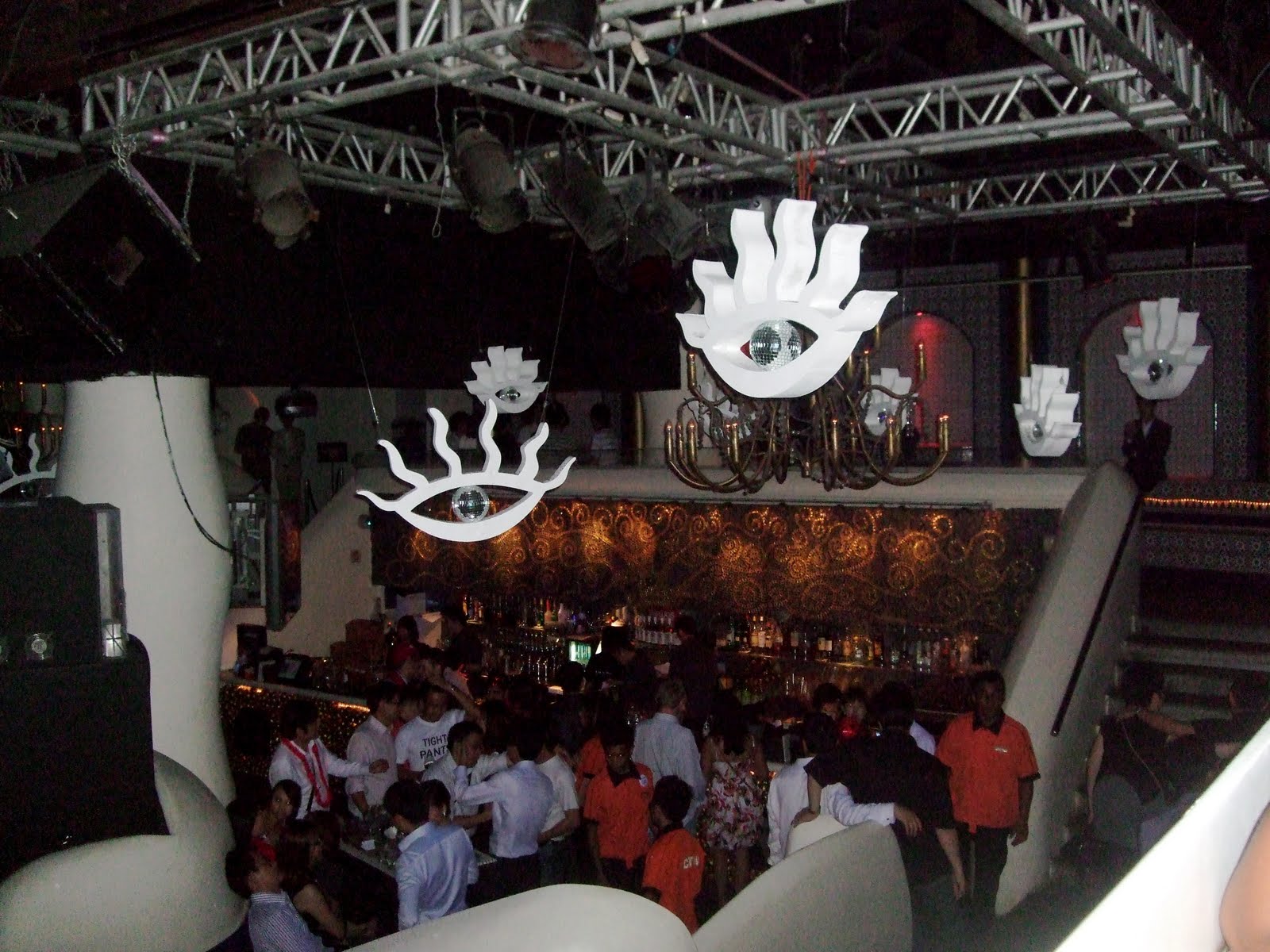
After all, Zouk is more than a bar, it’s an experience. I didn’t order any drinks, but I didn’t have to. The music was far too good to require any sort of substance to lower my dancing inhibitions. Lights, the shapes of open eyes, hung from the ceiling like modern chandeliers. The bar displayed an inlaid mother of pearl backsplash displaying dozens of liquors. The dance floor was a confusion of hips and sways, drinks and music. Umbrellas almost flew into people’s drinks, as they were prepared at lightning speed.

The interior of Zouk.
Bar tenders handed me a red masquerade mask and lay as I passed them, and I quickly added them to my costume. In the dim light which cast a whitish glow over much of our clothing (and some of our hair), the accessories almost accented my gray dress and blue-green beaded necklace. 
People ordered drinks: rum and cranberry juice, mint juleps, flavored spritzers, and a few of us even tried to order Shirley Temples (but the prices kept the Maraschino cherries safely behind the counter). Then we headed onto the dance floor. My favorite room played hip hop music. We got into the room early and danced until around 12:30 when the room got so congested you couldn’t move for traffic. Then we pushed our way into the mambo room where dancers took the stage to walk us through hand motions to older songs. Just as I was getting the hang of the waving arms and gesticulating elbows, my “dry” group decided to head back to the dorms. I was secretly relieved as I’d caught myself yawning in the middle of the YMCA. But I’m glad I went.
Now, I can say that my first bar ranked ninth in the world. I don’t plan to visit another bar unless it is ranked at least number eight. That means that the next time I’m at a bar, I’ll be in Manchester (#1), Berlin (#2), or, outside shot Lisbon (#3).

King Kong Trumps Fireworks Celebrating the 4th of July Outside of the USA

It was a different kind of 4th of July. No hot dogs or hamburgers. No singing of the National Anthem. No fireworks. I didn’t see one American flag waving or hear one mention of independence from the British. We didn’t receive any invitations for a cook out, and the only parties we were invited to, we later discovered had occurred a few days before the fourth. And so, the 4th of July came around and we discovered that we were Americans in a foreign country without plans to celebrate our independence. 
Still, in each of our own ways, we were determined to celebrate American style. We all mentioned going to McDonalds, and a few did to buy the apple pies we hadn’t had the foresight to bake ourselves. A few others went to Clark Key where they burned sparklers overlooking the waterfront. The rest of us embraced America’s international culture and treated ourselves to seafood prata at The Cheese Prata Shop. Afterwards, we wandered down the street to an Indian restaurant where we ordered Milo King Kongs, perhaps the best dessert I had while in Singapore as it was a large glass of chocolate milk chock full of milo (which is kin to Nesquick only MUCH better) and served with two scoops of chocolate and vanilla ice cream. Delicious!

At the Indian restaurant, enjoying my Milo King Kong.

Milo King Kongs Conquered!
We didn’t get our fireworks until that weekend when we took the metro to Marina Bay Sands to watch one of several rehearsals for Singapore’s 46th Independence Day celebration at the end of July. I’ve never seen more magnificent fireworks. White streamer-like fireworks shot from the tops of buildings and others exploded in star-like formations over the bay, casting red and purple hues over the Sands hotel. The finale ended with a cacophony of colorful explosions and several encores ensued even thirty minutes later. 
Fireworks over Marina Bay Sands during 4th of July Celebration Part 2.

Fireworks shooting off the tops of the buildings.
So, we celebrated the 4th of July Singapore-style (a.k.a. in multiple parts): first with our international rehearsal and then with our fireworks celebrating a different independence.

Bathing with Roosters and Speaking Without Words

When I say that we climbed a quarter mile uphill through a rainforest, I mean that the entire journey was straight up. No stairs. No railing. Just a few tethered ropes and a lot of mud. When we finally ascended the root-laden terrain, we mounted a tall scaffolding which provided a beautiful canopy view. I’d been to a rainforest before in Costa Rica, but this experience was completely different. Not only did it not rain once during our hike, but I also got much higher than I had before. I climbed to the top of the canopy with my friend Marquis. He spilled some water from one of the high bridges, and we watched as the stream separated into individual droplets, taking several seconds before they splattered noisily to the ground below.

Overlooking the rainforest canopy.
Afterwards, we took another boat ride (and when I say “boat” I should say rickety wooden canoe which bumped so hard against rocks so many times that the motor stalled every hundred yards or so) to the Iban Long House. The Iban tribe gave us as warm a welcome as our other Bruneian friends, only this reception included copious glasses of rice wine (while alcohol was prohibited in the rest of the Islamic country). Rice wine was handed to us at the door, served again at lunch and dinner, and given in large quantities at a fake wedding celebration later that evening. For those of us who didn’t drink, the evening involved lots of glass passing, and for those who did drink, it involved lots of glass downing. In the end, everyone was happy.

Boating to the Iban Long House.
After the first glass of wine, we were served a warm lunch of sweet rice cooked in bamboo stalks served with heavily salted chicken. We ate in the foyer of the Long House, which, living up to its name, consisted of a long hallway with fifteen doorways. Inside each doorway was an entire home (both upstairs and downstairs) where a family of nine or ten lived. The houses were not equal in status; some were rather modest, like our home which had no air conditioning and working fans in only some of the rooms, but others were rather posh, boasting televisions and running showers.
We broke into pairs for rooming assignments. Toyosi and I were assigned House 14. Our family had nine children ranging in ages from five to 22. The youngest was celebrating her birthday the day we arrived. The oldest had previously worked as the sultan’s personal cook and spoke of baking him chicken pie. (I had hoped to awake the next morning to a twelve course breakfast, but my lack of royal blood reduced me to an excellent breakfast of brown sugar rice and fried spring rolls instead.)

We talked with our family for hours on end. We were lucky as many of our contemporaries were assigned families who couldn’t speak any English. We came across this problem only with the mother and the young boys (the latter of which probably could speak English but were too busy boasting that they enjoyed “smokes” at the young ages of eight and ten). We met some of the younger girl’s friends who listened to us read from their Malay chapter books and laughed at our misguided pronunciations.

Toyosi and I with our housemother and two youngest "siblings," Suraya and Sita.
Later in the afternoon we went for a quick swim in the lake and then we returned for showers before cooking lessons. Bathing proved difficult as the shower consisted of a bucket and hose. I showered twice, first with a bath rag, and then, by spooning yellow water over my head and each limb; both times I showered to the clucking of roosters in the back yard. I left the shower feeling dirtier than I’d come.
Washed and dried, I wandered inside another Iban house for cooking lessons. I sat on the ground with an elderly woman and stuffed greens into hollow bamboo stalks with a silver spoon, pounding the stalks every few spoonfuls to make room for more vegetables. I watched as the packed stalks were set over a roaring flame and engulfed in smoke. To the side, vats filled with boiling rice and stewing chicken bubbled and hissed.
Stuffing greens into hollow bamboo stalks.
Then, I joined a circle of classmates to shell hard-boiled eggs. I was unlucky enough to de-shell my first egg only to discover that the hardened yoke had burst through the white. “It’s ugly, you have to eat it,” one of my friends told me, explaining that they’d been told aesthetics mattered for the dish but waste wasn’t tolerated. Luckily, I was sitting by Malhar who loved hard boiled eggs and agreed to eat mine. He also agreed to eat every other girl’s ruined eggs and soon felt quite ill. From then on, I was careful about which eggs I selected.
Saffa and Ceewin shelling hard boiled eggs.
Finally, we made our way to the dessert table where we were handed a long rod with a coconut shell with holes tied to the end. We filled the coconut shell with a thick batter and then poured it into a frying pan sizzling with hot oil. Running through the small holes, the batter made a netting-like formation. As it began to harden, we folded it in half with a spatula and then in half again, careful not to flatten the air from its edges. Upon sampling, it tasted like sweet cinnamon, reminding me of the fried tortilla dessert you can order at many typical Mexican restaurants. 

Hui Qian, our Program Assistant, tries her hand at the "netting" dessert.
After a quick dinner enjoyed cross-legged on the floor (dinner preparation was the more social aspect of dinner; the actual eating took very little time), we joined the elderly ladies for bamboo weaving lessons. I spent the next few hours entwining bamboo leaves into place mats and table settings. I became fast friends with one lady in particular who couldn’t speak any English. I learned by watching her patterns and then following her directions of head shakes (meaning, “no”) and humming (meaning, “yes”). Then, once I’d caught hold of the pattern, I taught my friends. When Roxanne and I left, we’d grossed four place mats and two place settings combined. I felt like my fingernails would fall off when I finally stood up to return my goods to my room.

Weaving place mats with our feet and fingers.

Roxanne, our "grandmother," and I (several hours later) with our finished products!
Then we joined the rest of our classmates for a fake wedding party, joining Madison and Ian (two of the students on the trip) in matrimony. Basically an Iban wedding is just an excuse to drink massive amounts of rice wine. Rice wine was drunk before, during, and after the ceremony. It was especially important during the three loops around the hall which the married couple must make to seal their vows. After each circle, everyone in the wedding party (including guests) had to down a glass of wine. At the end of the ceremony, we were told that the tradition had been westernized for us tourists and that in actuality the wedding party would drink a glass of wine at each doorway. With fifteen doors passed three times each, that adds up to 45 glasses of wine, not taking into account the other glasses consumed at either end of the ceremony. What baffled me most was that the wedding couple is not allowed to sleep during their first night of marriage and must instead keep awake all night playing board games. I can’t imagine the level of concentration required to play Mancala after 50+ drinks. Counting marbles can prove difficult even sober and well-rested.

The happy couple, Ian and Madison.
The wedding ceremony was also filled with dancing. The traditional lady’s dance involved soft arm movements and careful twirls, but I preferred the male’s dance which consisted of a series of sharp stomps. I’d never heard such a loud sound as the dancer made with his bare heel. It was genuinely impressive and sent me jumping every time. The girls had the chance to try the lady’s dance and the guys had the chance to follow the male dancer. When it came to the stomping, the male lead broke into fits of laughter at our classmates’ harried attempts.
I'm not sure that I should call this dancing. Maybe just "The Attempt."
Leaving the Iban village foreshadowed the tearful farewells we’d make to our other Bruneian friends first at the University and then again at the airport. The Iban villagers lined up along the vast hallway, each touching their hearts and then their lips as they wished us farewell. My weaver friend, which I’d come to accept as a surrogate grandmother of sorts, had tears in her eyes as she pulled me close. 

Saying, "goodbye," to a few of our many friends from the University of Brunei.

We had not been able to speak with many of the villagers, yet we’d found a more meaningful style of communication: one through the heart and eyes. But with the help of language and time, we’d grown even closer to the students and professors at the University of Brunei, and so leaving them was doubly hard. I don’t know if I’ll ever have the chance to return to Brunei, but I do know that whether I visit in person or not, a small part of my heart will always remain with the people who live there.

Allow Me to Introduce You to My Good Friend, Brunei

I’m sure you’re already well-versed in the geography, politics, and religious status of the small country of Brunei Darussalam. But in case you’re not, Brunei is located in the north coast of the island of Borneo. Ruled by a sultan, it is one of the last absolute monarchies on earth. Separation of church and state have no place in Brunei; the sultan and his father both funded posh mosques, and in recent years the sultan even officiated a service. Islam rules the land.


Outside the sultan's mosque.
Yet many stereotypes which would normally follow such a description have no place in Brunei. The people we talked to spoke of America with regard and genuine fondness. Many wanted to come visit. One of the university students we met was openly gay, and he did not seem to find much resentment amongst his fellow citizens; in fact, he talked about once dating the sultan’s son. Also, contrary to popular thought, as absolute ruler, the sultan is not hated but loved. Brunians talked expectantly about the sultan’s upcoming 65th birthday, sighing over the fact that we’d come a few weeks too early to enjoy the July celebration which would close down the streets for a month of parades and festivals.


We only visited Brunei for five days, but the memories we made and the friendships we formed will last much longer. I haven’t come across more beautiful hospitality. Everything from fluffy pillows to bedroom shoes to ironing boards were provided in our posh suite-style dorm rooms. Breakfast, lunch, and dinner were also served free of charge. And entertainment came in varying forms every night: dance lessons from a Bruneian dance team; cooking classes from our linguistics professor’s wife who prepared ambuyat, a typical dish; Malay language and Arabic writing lessons where we learned how to write our names in Jawi script; a walking feast through the night stands where we tried everything from sweetened cow’s heart to skewered chicken butt; and an afternoon boat tour to see proboscis monkeys swinging through vines in their natural habitat. (Also on this tour, we got a view of the sultan’s backyard, or rather a very blurred view of the back tip of a golden dome which is a small part of the largest real estate in the world.)


In anticipation of trying chicken BUTT. Wonderful flavor.

On the boat ride to see proboscis monkeys. 
One of the most magical moments of the trip was when we took a detour through Empire Hotel (a SIX star hotel) and snuck onto its private beach where we bathed in the South China Sea and then climbed onto steep rocks to watch the sunset. The sky seemed to split apart and break into a thousand radiant rays of pinks and purples. The waning light cast a golden glow over the water, and a complete stillness coursed through my veins as if life truly made sense even if only for a moment. 


The Empire Hotel. This is what SIX stars looks like!

Watching the sunset on the South China Sea.

Upon leaving the beach, I stopped inside the bathroom. After all, I’d toured several five-star hotel restrooms in Singapore, and I wanted to see how a six-star hotel in the richest country per capita in the world could top them. The marble flooring, golden spigots, room-sized bathroom stalls, and fresh roses reflected a thousand times in the wall-length mirrors did not disappoint. 


Yes, it really was that beautiful.

Reflecting on my entire trip abroad, I always return to that special night on the South China Sea as one of my most special moments. When I read in the news that six Asian countries, including China, Vietnam, and the Philippines, are currently vying for ownership of the sea, I understand why. Sure, politically, it’s desired for its possible oil and gas revenues, but, personally, I think the politicians just want an excuse to spend the evening as I did, bathing in the warm waters and enjoying the magnificent vistas afforded by jagged rocks and majestic sunsets.

Saturday, July 2, 2011

Sir Classic Tailor

Before leaving for Singapore, a family friend, Joe Brasier, had told me by way of my grandmother, about a fabulous tailor shop in Chinatown called Sir Classic Tailor. A few days before leaving for Brunei, I set out for the shop on my own by way of the MRT (subway station). 
I had a bit of difficulty finding the shop, wandering down street after street, waving aside invitations to buy everything from pink “I ♥ Singapore” t-shirts to large fans the size of bookcases. Eventually, I found a nice businessman in a dark suit who told me to go down Pagoda Street where most of the tailor shops can be found. “But why are you looking for a tailor?” he asked me, brow furrowed. “It’s quite expensive.”
“I’m just looking,” I assured him.
He shook his head. “They don’t like you to look. They like you to buy,” he said. With his warning still echoing in my head and his friendly wave upon my retreating back, I climbed the stairs, crossed a bridge, and headed toward Pagoda Street. Just when I was about to give up, I came across a beautiful shop with a bright green sign reading “Sir Classic Tailor.” Taking a deep breath, I walked inside. 
A salesman named Silva proved immediately attentive, recommending the best of the raw Italian silks. I told him I wanted a white silk suit like I’d admired in Singapore’s central business district. As we flipped through swatches and tagged different design samples, we discussed prices. After telling Silva that I’d been recommended to the shop by a family friend and was a non-working student, I managed to get a rather good price. “I think I remember Joe,” he said. 
Silva even walked me to the ATM where he stood at a distance so I could withdraw cash. I ordered a white raw Thai silky suit, and then the seamstress, Joan, took my measurements. As I paid, I noticed a bulletin board featuring the shop’s more famous clients, among them, Bill Clinton. Only in Chinatown in a country where the U.S. dollar still trumps the Singapore dollar could I afford to be in such company!

Standing outside Sir Classic Tailor after ordering my suit.

I returned for my first suit fitting this past Friday afternoon (July 1st) after coming back from Brunei. A man greeted me at the door and asked me to wait for Joan who was in the back room. She emerged a few moments later and immediately grabbed my short white jacket. “Two people saw it before you came in and requested the same design,” she told me, beaming.
I, too, was beaming when I put on the jacket. As I had to wait a few minutes for my skirt to be delivered, I sat at the counter, and Joan asked about my trip to Brunei and offered me a Coca-Cola which I accepted gratefully. Then we discussed shirt designs and I looked through a case of handmade raw silk ties. When the skirt arrived, I tried on the entire suit and couldn’t have been happier. (Actually, Joan disagreed, insisting that a handmade shirt under the jacket would be preferable to anything I could buy in other stores. She told me she’d give me a special discount if I returned, and I agreed to think about it.)

Posing with Joan after trying on my suit. (I think I understand what she means when she says I need to invest in a nice dress shirt. Somehow my green t-shirt detracts.)

I did return the very next day with my friend, Roxanne, who wanted to do some last-minute souvenire shopping for her brothers. Roxanne was blown away by my reception when I entered the shop. “Hello,” the man who’d greeted me the day before, said as I walked inside. “How do you like your suit?” I told him I loved it and had come back for the shirt.
“An excellent idea,” Joan beamed, gathering the books of swatches.
“How was Brunei, Emily?” Silva asked me as he pulled down bolts of cloth for another customer. “Can I get you a drink?”
Roxanne was wide-eyed as I sipped my Coke. She wandered off to some other shops while I admired a new assortment of silk ties and picked out my shirt material: pink and white striped Egyptian cotton. I return for my trial fitting Thursday. 

When Fourteen Means Forty: A Story of Tandem Bikes, Conquered Chili Crab & Messages in a Bottle

We left the dorms early one Saturday morning (June 18th) for Pulau Ubin, a tiny island filled with beautiful forests and seafront property. The island harkens back to 1960s Singapore with the  country’s last kampong village, a series of houses built on stilts surrounding the waterfront. (The rest have been torn down to make room for more Housing and Development Board flats.)
A hefty cab fare and a short ferry ride later, we finally arrived in Pulau Ubin for a day of island biking and hiking. The bumboats, which took us to the island, held exactly twelve people and the drivers wouldn’t leave until the boats were filled, so we had to wait at Changi until enough passengers arrived. Then we fished in our purses for the $S2.50 one-way fare.

View from the bumboat.

The boats were built sturdily and made gigantic waves as we sailed. The large, open spaces for windows provided a great view of Kampong Glam. The wind whipped my hair into a frenzy, blowing my ponytail like a ferris wheel and forming curly wisps around my forehead. 

In case you didn't believe me about my hair.

Upon entering the island, we were bombarded with a stretch of salespeople offering us bikes for the day beginning at $S8. By the time we’d reached the end of the row, we could rent a bike for just $S4. As I needed to ride a tandem (bikes and I have had a rather unsteady relationship in the past), my friend, Marquis, and I split the cost of a $S12 two-seater. Our height discrepancy is such that his seat was boosted to its full height while mine sat far below, making us look all the more comical as we took sharp turns. 

Mandy, Marquis, Toyosi, Olivia, CeCe and I arrive in Pelau Ubin!

Before we started, Marquis informed me he’d never ridden a tandem, but he didn’t think it would be very different from a regular bike. I had flashbacks to my first few tandem rides with my dad, remembering our rather precarious endeavors and difficulty climbing hills. Uh oh, I thought, but I just smiled and tried to think, unsuccessfully, of something both encouraging and truthful to say. I settled on a non-committal noise meant to convey confident anticipation. In reality I was terrified. 
As soon as we took off, we knew we’d made a mistake and should’ve invested in the slightly more expensive tandems for $S16. Our first and second gears were nonexistent and our brakes squealed like a dying bird. We took off in a swervy zig-zag and pressed on the breaks, turning heads. The lady who sold us the bike shouted at our retreating backs, reminding us to take the downhills slowly and to watch out for jagged curves. I tried to ignore her worried tone and anxious expression, but as we screeched to a halt behind the rest of our group, I had a hard time shaking a deep sense of foreboding. 

Marquis, Mandy, Cece, Ashley, and I bike through Pelau Ubin.

Despite my concerns, we didn’t fall once. Sure, we had a few close calls, like when an entire school group appeared from no where as we practically flew downhill on one wheel. But we not only made it through completely in tact, we also spent an entire day touring a good portion of the island, stopping to admire seemingly endless vistas: row upon row of palms and coconut trees lining a wide dirt path, a small inlet of water surrounded my a patchwork of grass and mud which was chock full of antique glass bottles, an old well with overhanging ivy hidden within a spice garden, and a small shrine dedicated to a “German Girl” atop a steep hill. Along the way we came across discarded piles of fresh fruit like the ripe durians we spent a good twenty minutes trying to crack against the concrete with no success. 
We stopped for lunch at a wonderful seafood shack built right along the shore. The water lolled in gentle waves against the stilt support structure and crabs crawled around a large tank of water a few paces away from our table. 
As we’d broken into small groups for the bike ride, we were pleased to run into another group of SEAS people already seated at the restaurant. They told us the seafood was excellent and Jessica and Malhar suggested the Chili Crab, a Singaporean delicacy, which the waiter had told them was only $S14.00. Cece and I decided to split the dish which was served in a spicy dark sauce. As it was impossible to eat the crab with utensils, we pulled the meat from the shell with our fingers. The head and pinchers were especially good dipped in the thick sauce. As we were embarking on the rather meatless thighs, Jessica and Malhar got their bill.

The best "$S14" Chili Crab in Singapore!

“Hey, guys.” Malhar’s voice didn’t sound like someone who’d just paid $S14 for Chili Crab. “You know when the waiter told us $S14?”
We sucked air in affirmation.
“Well, we misunderstood,” Malhar said slowly. “Apparently, he said $S40.”
Cece and I looked at each other. “We’re not leaving one bite,” I told her.
“I’m going to ask for a spoon for the sauce,” she said, nodding assent. 
We conquered the Chili Crab, and then I had to conquer the bill when the waiter asked for $S45 instead of $S40. I was nice but firm; after a large smile and friendly reminder on my part, he left with the bill and returned a moment later with the changed price. We considered taking the shell as a trophy but decided against it.
After lunch, we biked to the seashore where we discovered old bottles poking out of white sand imported from Hawaii. We unearthed several and cleaned them in the water. Then we ripped pages from our journals and wrote notes (to be discovered 200 years from now). We were sure to date the letters for future historical legitimacy. We pushed them through the long neck of the cleanest bottle and prepared to send it off to sea. 
Message in a bottle.


But before we did so, we came across a fallen coconut. We split it open and after smelling the spoiled milk inside, poured it onto a nearby rock. Then, we shoved the bottle into the coconut (which served as a flotation device) and lowered it into the water with the receding tide. As we remounted our bikes and continued our tour of the island, we told ourselves that our letters wouldn’t be discovered for hundreds of years. In all probability, they were quickly retrieved and read by the slew of kids who’d just arrived on shore and had watched our progress with attentive eyes. But we pedaled fast, so we’ll never know for sure.

Off to sea!

Friday, July 1, 2011

“Quek” Like a Duck and Other Professors


My previous blogs have almost completely disregarded the fact that I’m studying while abroad. I’ll try to correct that misconception with a quick exposé on each of my professors from the National University of Singapore (NUS), each to be completed in different entries.
I have classes from 9 a.m. to noon Monday through Friday. Besides a South Asian literature and film course which we are taking under two UNC professors, we are also enrolled in “History of Singapore, Malaysia, and Thailand.” A different professor from NUS specializes in each country. During the first two weeks we focused on the formation of the Singaporean identity (or, rather, a failure to do so). As Singapore split from Malaysia in 1965, the next segment of our course focused on the history of Malaysia so we could draw parallels between the two countries’ social situations. We are currently studying Thai history, but our professor promises we will soon be discussing current politics which will be fascinating considering the upcoming (and potentially explosive) elections in July.
When Dr. Quek Ser Hwee, our professor for the Singapore segment, introduced herself, she told us about the confusion her name caused when she studied in the United States. While “Quek” comes at the front of her name, it is actually her surname. (The Chinese place their surnames ahead of their given names.) To add to the challenge, it is pronounced, “Quack, like the duck.” She repeated this several times, assuring us that we weren’t being disrespectful if we quacked in class. (Apparently, her professors in the United States hadn’t wanted to make duck references and so they’d insisted on using her given name, Ser, “which is pronounced, ‘sir,’” she told us. “So you can imagine the discomfort those stogy old men felt when they used their own title on me.”)
Professor Quek kept us laughing in class. Soaring to an incredible height of five feet, she commanded attention through humor. I could have filled an entire notebook with her one-liners. Using Powerpoint presentations only when convenient, each morning she leaned against her desk, sipping a Coke and just started talking. Her favorite rants included the many shortcomings of former Prime Minister Lee Kuan Yew (who, as an octagenerian Ministry Mentor, is still very much in the spotlight) and the many shortcomings of Singapore (all of which she can trace back to Lee Kuan Yew). “Many of my students say I act like I hate Singapore,” she said during one of our first classes. She brushed back her short dark hair, a gesture we came to recognize as her one-liner signal, and continued. “And I tell them, ‘You’re right. I do!’” 
But Professor Quek didn’t really seem to hate Singapore. In fact, her frustrations bespoke a deep love for her country and a desire to make it better for the people who live here. Our most interesting conversations (for “lectures” would defame her style) revolved around Singapore’s lack of a national identity. The root of this problem lies in the way the government denotes ethnicity. Citizens must identify themselves based on the Chinese-Malay-Indian-Other (CMIO) model which forces them into boxes where they don’t belong. The CMIO model exacerbates inter-ethnic tensions and causes people to identify themselves and others based first on race. Further, the CMIO model doesn’t allow children of mixed races to express a dual identity. They simply have to choose a race. (This is the new and improved version. Before 2010, a mixed-race child was simply assigned his father’s ethnicity.) I wrote my final paper for Professor Quek on this model, and since her class I’ve become really interested in national and sub-group identities. In fact, SEAS 2010 and 2011 students have the chance to apply to return to the program next year for an individual research project, and I would really like to study the formation of ethnic identities in depth next year.
Two Sundays ago (June 19th), Professor Quek took several of us to church at St. Andrew’s Cathedral, the Diocese of Singapore. We had to take two buses and the metro to get across town. When we finally arrived, the church was overflowing with worshippers, some leaving the 9:30 a.m. Mandarin service and some coming for the 11:15 English service. 

Inside St. Andrew's Cathedral.

Fourteen services are conducted each Sunday in a smattering of languages ranging from Cantonese to Bahasa Indonesian to Tagalong, a word I thought was reserved for a type of Girl Scout cookie. The styles varied as well, some were traditional, others contemporary, and still others offered options with and without communion.
In what is starting to seem like a trend, I was blown away by the cathedral’s architecture. Tall windows with intricate molding lit the church’s front, and long white spires pierced wispy clouds. The cross, atop the steeple, was almost lost to the sun’s blinding light. Inside, people were already kneeling in prayer. 
When the service started, I quickly understood what Kerri Nicole, a SEAS Episcopalian who also came to church, meant when she referred to “pew aerobics.” We certainly did our fair share of rising and kneeling. In fact, a pattern emerged: Kneel. Pray. Stand. Sing. Sit. Repeat. I had the horrible urge to start counting repetitions.
Despite the workout, the service was wonderful. The church hosted a professor from a Singaporean theology school, who preached about finding God in the simple and everyday. He seamlessly incorporated Father’s Day into the lesson, talking about how a child tends to envision God as someone a lot like his father – quite a responsibility if you ask me!
I was overcome by the size of the sanctuary. We sat towards the back and had to strain to see the preacher’s face. I was thankful for the large screen televisions placed every two rows so I could watch the service, and I was even more thankful for the music lyrics and prayers posted on the same screens as we must have used twelve different books none of which I could find until the next song or prayer was being recited.
Although the church was huge and we sat hip-to-hip for row upon row, I was amazed at the speed of communion. Only baptized churchgoers could receive the host, so those who could not partake in communion were instructed to turn their hands over for a blessing. The priests dolled out the wine and wafers much like workers on an assembly line cap bottles: efficiently and impersonally. Had I not known the blessing said over the host, I certainly wouldn’t have understood the syllabic slur uttered in my direction. Accustomed to kneeling for prayer after communion, I was surprised when the priest blessed me on his second round around the communion railing. Apparently, my folded hands resembled the gesture unbaptized gesture, so I received a double blessing.
Although I didn’t particularly enjoy communion, everything else about the church was inclusive and open. One of the priests (there was a handful– all balding and all unusually merry) even asked members to stand, and although I was one of the first people to sit back down, the ushers still managed to slide me some welcoming materials down the pew.
After church, Professor Quek insisted on treating us to a Burmese lunch. “I don’t know if it’s authentic, but I know that it’s good,” she told us as we walked to the Burmese hawker center. “Because all the Burmese workers come here.” I repeat my professor’s sentiment entirely: I have no idea if it was authentic cuisine, but it certainly was good, and we certainly were the only non-Burmese in the restaurant. 

Professor Quek and Toyosi Oyelowo enjoying Burmese cuisine.

And on the other side of the table, Ceewin Louder, Kerri Nicole, and I doing exactly the same thing!

Professor Quek ordered us each a different fruit drink (I tried mango) and then we commenced hors’deauvres: fried fish patties and a mango and papaya salad with shrimp. We also enjoyed a seafood/ vegetable platter with shrimp, octopus, mushrooms, and broccoli. Our main courses were served last. I enjoyed seafood rice which came with shrimp, octopus, and prawns along with a mess of vegetables served in a thick clear sauce. 

In case you wanted a visual.


The food was savory, but the conversation was even better. We discussed everything from the sermon to trying to identify Singaporean identity to the problem with Singaporean men (mainly that they’re unromantic). In my opinion, it’s a universal problem and certainly not singular to Singapore, but I digress. (And to my offended guy friends: while I stand by my claim that the lack of romance is a universal male problem, I’m not charging 100% of males with the misdemeanor, just 99.9999999999999999%.)
The following day, Professor Quek organized a movie showing called “Singapore Dreaming.” She said she’s not proud of many Singaporean films, as most of the actors have “beautiful faces and zero acting skills,” but “Singaporean Dreaming” is exceptional as the actors have both good looks and talent. The movie revolves around the Five Cs (or the top five Singaporean ambitions): cash, car, credit card, Condominium, and Country club membership. “Singapore Dreaming” also refers to the lesser-known sixth C which trumps all others: Coffin. I definitely recommend watching it if you’re in the mood for a dark comedy with Singaporean flare. And when I say “Singaporean Flare,” I’m referring to the witticisms and humor which can only come from a woman exactly five feet tall with short cropped hair and a name befitting an entitled duck.