Pages

Total Pageviews

Popular Posts

Showing posts with label Ernest Hemingway. Show all posts

Thursday, August 8, 2013

Across the Canal and Into the Bar


On the Road with Hemingway - Venice, Italy

Gondolas gliding along the Venetian canals.
Almost all Ernest Hemingway travelers I’ve come across make a beeline to Harry’s Bar as soon as they hit Venice. But, while the bar was one of the writer’s favorite places in the city (Hemingway even had his own table in the corner by the window and was served a Montgomery – a dry martini 15 parts gin to one part vermouth – as he sat down), going straight to Harry’s upon arrival is certainly very un-Hemingway. For one thing, Hemingway would have visited several bars on his way to Harry’s (it’s a long walk from docking). And second, there is far too much to see in Venice to spend your first moments in the city closed off in a bar – even one as beautiful as Harry’s.


So instead, of hitting Harry’s bar as soon as I arrived in Venice, I decided instead to walk around the city. I enjoyed breathtaking views of the bright, arching bridges and shimmering canals. I dined at a seaside café and watched a boat race. I enjoyed my first gondola ride, skimming past history to the soothing songs of my gondolier, stopping only once when we got caught in a gondola traffic jam under a bridge. We skirted between tight passageways – crumbling brick buildings on one side and golden stucco buildings and window boxes bursting with red and purple begonias on the other. Dusk fell, setting the clouds on fire and the water twinkling in pinks and golds.

Posing with the owner of the mask shop, after finding the perfect mask.
 I dipped inside a small mask-making shop and met the man who had owned the place for over 20 years. “I don’t use plastic,” the owner told me proudly. “Just papier-mâché.” I tried on columbina half-faced cat masks, full-faced bautas with gold trimming around the eyes and bright green feathers pluming from the top. I tried a two-faced jester: one face grinning the other crying. And then I saw it: hanging in a far corner of the shop: a beautiful volto mask, covering the chin and forehead, with bright red lips, cracked white face and antique religious motifs along the arched cheeks and forehead blooming with taffeta and bells. I tried it on, and, looking through the mask asked him the price.

Pro-abortion protest inside Basilica di San Marco.
I attended a church service at Basilica di San Marco and witnessed a pro-abortion protest in the midst of the service – dozens of supporters holding up signs with the start of every hymn. I sat in the Piazza San Marco and enjoyed the live orchestra at Caffé Florian (the oldest café in Italy) over an incredible Coppa Caffé Florian – a decadent concoction of coffee gelato, tiramisu, chocolate and Florian coffee liqueur and topped with whipped cream, chocolate sauce and pirouette cookies. I watched the pigeons circle the piazza, listened to the bell toll in the Campanile and then climbed it myself for great views of the city.

Decadence at Caffé Florian
Coppa Caffé Florian

View from the top of the Campanile.
I walked along twisty stone paths on my way to The Gritti Palace – a gorgeous, ornately decorated hotel on Campo Santa Maria del Giglio. Being a fine, elegant hotel facing the water, it quickly became another one of Hemingway’s favorite hangouts. Both Hemingway and the English novelist W. Somerset Maugham called The Gritti their home back in the 1950s and ‘60s. Hemingway wrote much of his initially unsuccessful novel Across the River and Into the Trees in his grand Presidential suite with a picturesque view of the Grand Canal. Wandering onto the Gritti terrace, Hemingway would dine on scampi and a bottle of Vapolicella while watching the gondolas skimming by.

View of the Grand Canal from inside The Gritti Palace.
I spent a luxurious evening at the Gritti’s Longhi Bar drinking daiquiris. The snug bar was caked in colorful Murano glass sconces and huge hand-carved mirrors displaying cherubs and the fleur de lis. Sipping my daiquiri and nibbling on pitted olives and mixed nuts, I enjoyed my prime view, overlooking the Grand Canal – watching couples ducking into gondolas, bottles of wine in tow.

Enjoying a daiquiri inside the Gritti's Longhi Bar.
I imagined how different it would have been for Hemingway sitting on that very terrace on January 25, 1954, reading his own obituary almost 60 years before. The New York Daily Mirror’s presumptive headline read: “HEMINGWAY, WIFE, KILLED IN AIR CRASH.” Hemingway and his fourth wife, Mary, had been flying over an East African jungle on their way to Murchison Falls on the Nile for a safari, when their plane crashed. But neither died. (The only way Hemingway ever got rid of his wives was by divorcing them.)

Enjoying the view from the Gritti's terrace,
overlooking the Grand Canal.
Although Hemingway was banged up a bit with injuries affecting everything from his skull, shoulder and spine to his liver and kidneys, instead of going home to recuperate, he headed to the Gritti, where he drank large doses of champagne in lieu of medicine and played baseball with friends in his suite, knocking out a window in the process. When the manager of the Gritti found out, he was impressed – not angered – by the damage, proclaiming that after 300 years of existence, Hemingway was the first person to play baseball in the Gritti and so he would “reduce Signor Hemingway’s bill by ten per cent.” I am more careful of my surroundings as I finish my long drink, toasting Hemingway’s safari survival and trip to Venice.
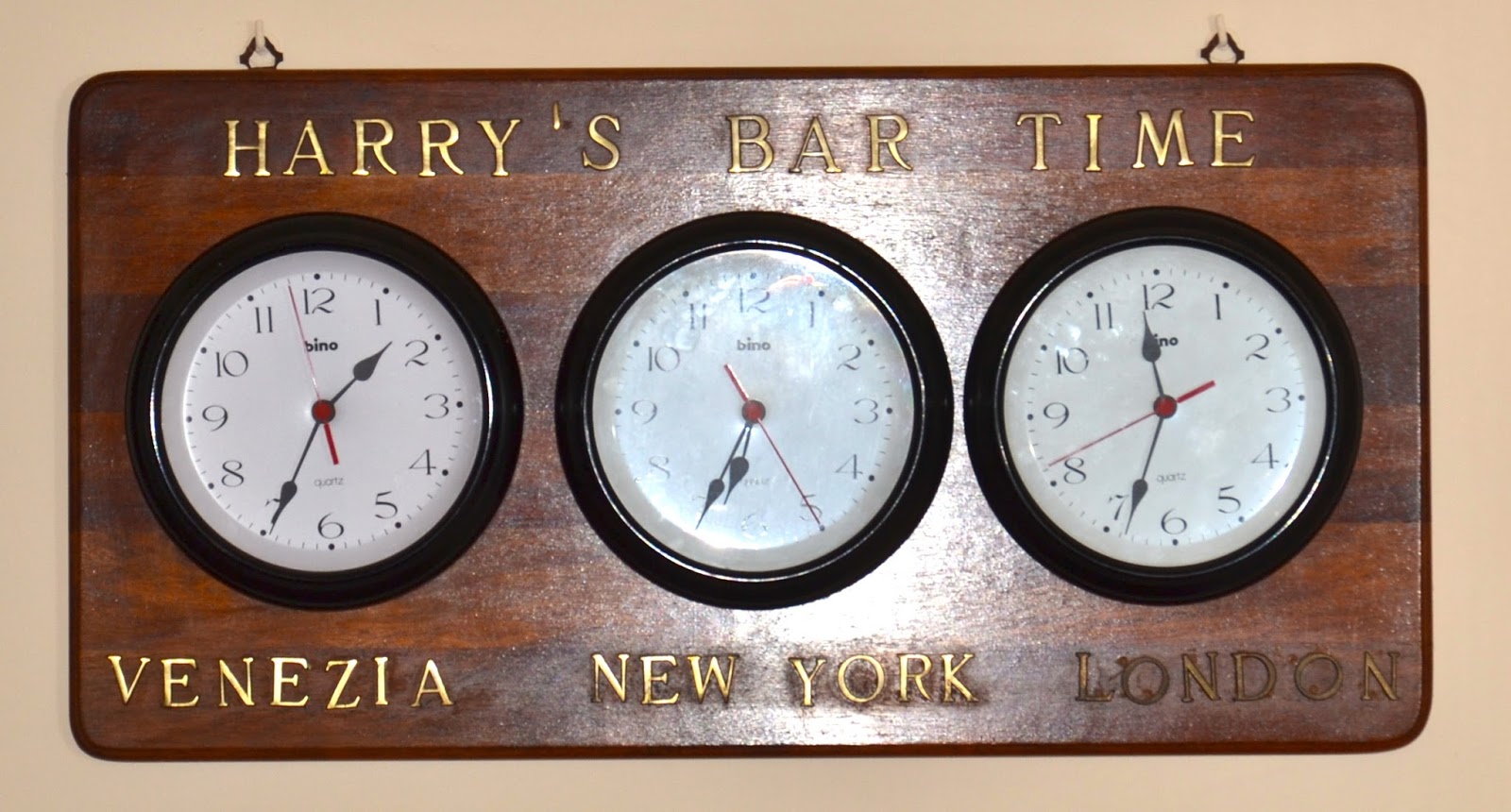
The infamous clocks hanging on the wall at Harry's Bar. Because the
only time that matters is Harry's Bar Time.
And, eventually, (on my second day in the city), I arrive at Harry’s Bar, just in time for brunch. I order a Bellini. The choice of a white peach cocktail composed of one part white peach puree to three parts Prosecco was quite un-Hemingway. For one thing, the drink would not be nearly strong enough for a man who claims to have lived in Paris off of a diet of clementines and cherry brandy. For another, the drink is pinkish and bubbly – hardly a Manly Man’s drink. But if I’ve learned anything from my trip tracking Hemingway’s path from journalist to novelist all across Europe it is that as a young, single woman, slight of build, it’s dangerous to act too much like Hemingway. Living on a diet of clementines and cherry brandy? (Couldn’t do it if I wanted to and wouldn’t want to – especially in Paris!). Besides, as an aspiring foreign correspondent, I could have easily ended up as Hemingway’s fifth wife. Two of his four were war correspondents; he divorced Martha Gellhorn because she was too much competition in the field, and Mary Welsh survived marriage simply because she survived Hemingway.

Toasting Hemingway with a Bellini at Harry's Bar.
 So I happily sat at the bar, sipping my Bellini (named for the Italian artist, as opposed to the Montgomery, which is the namesake of a British field marshal) and envied only Hemingway’s prime seat, overlooking the glimmering canals. The Bellini was simultaneously sweet and tart, the Prosecco rich and bubbly.

I befriended the bartender (per Hemingway’s suggestion – the man was on a first-name basis with bartenders all over the world), and the bartender promptly removed a thin book from a shelf behind the bar and opened it to a dog-eared page about Hemingway.

“That’s the owner and Hemingway,” he told me, pointing to a picture of two men, one clean-shaven, the other bearded, and both wearing sombreros. Both appeared drunk out of their minds, with Hemingway staring at an empty glass as if it were his long-lost lover.

The bartender, Giuseppe, told me that the book had been written by the owner’s son, Harry (who was named after the bar, not the other way around; the bar, consequently, was named after a customer – obviously one before Hemingway’s time).

I read the caption beneath the black and white picture:

My father is smiling in the picture, but Hemingway, with his gray beard, looks lost in a dream before a flood of empty glasses. My father and Hemingway had apparently emptied those glasses, and I remember that it took my father three days to recover from his hangover.

If you didn’t understand what I meant by the importance of not mimicking Hemingway too closely, now you do. Giving a famous bartender a three-day hangover is no small accomplishment!

But to understand this Hemingway – the one of Venice – we must take a look at the events in his life that took place between his Italian debut venture to Milan (a war can hardly be called a trip) and his eventual return as a carefree tourist in Venice. A young teenager just one month shy of his 19th birthday arrived in Milan on assignment as a Red Cross ambulance driver for the Italian army back in 1918. But when Hemingway first stepped onto the watery canals of Venice, it was the summer of 1949, and he was already the well-established author of a number of novels including, most famously, A Farewell to Arms and For Whom the Bell Tolls. He is also on his fourth and final wife. He has enjoyed the roaring twenties along expats Gertrude Stein, Ezra Pound and the Fitzgeralds (among others), and he has managed to have falling-outs with nearly everyone he’s met, including three former wives. He has jumped countries and continents from Paris to the Key West to Spain (for the bullfights) to Kenya (for a 10-week safari), back to Spain to report on the civil war and then on to Cuba (the country claiming his most consummate relationship for he lived there for 20 years, albeit flings with other countries).


With all of this in his background, Hemingway arrived in Venice independently wealthy but still rather grim. He had enjoyed critical acclaim and popularity for his writing, but while in Venice he would go on to write what critics dubbed his first flop: Across the River and into the Trees – about the last day of a man’s life and the memories he focuses on just before dying. Perhaps the critics were hoping for something a bit more on the cheery side. Only Tennessee Williams of the New York Times said anything positive about the novel when it was first released. (And I guess if you can only have one fan, Tennessee Williams of the New York Times is a good one to have.)

Once, while at the Gritti Hemingway took Adriana Ivancich, a Venetian aristocrat and his love interest at the time, onto the Gritti terrace at sunset. And, according to a People magazine article published in 1980 (Adriana’s tell-all in which she revealed herself as the inspiration for the teenage Renata in Across the River and Into the Trees), Hemingway began to cry. “Look, daughter,” Hemingway told her. “Now you can tell everyone you saw Ernest Hemingway cry.”


I have a hard time imagining the man’s eyes even welling, not to mention actual tear drops and glistening cheeks, but the man was certainly a performer and an exaggerator – hyperbolizing even his poverty – so that perhaps he was not always quite the manly man he appeared in Pamplona when he took his pregnant wife to see the Running of the Bulls to toughen up his unborn son.

But Hemingway could always escape the pains of his life for the white tablecloths, wide windows and Montgomerys of Harry’s Bar. And as I toast Hemingway over my Bellini I can understand why he came here. People flit in and out for Sunday brunch, talking and laughing and exclaiming over the history of the place. And for a moment the diners clustered around Hemingway’s favorite table disappear and I see a man in a sombrero, a “flood of empty glasses” before him, sipping a Montgomery and refining his novel about death – a novel that would not be appreciated until years after his own.

Wednesday, August 7, 2013

Ever After from Milan


On the Road with Hemingway - Milan, Italy


The cathedral "white and wet in the mist."
Milan is a city begging for a fairytale. It was practically designed with Disney in mind. A director’s dream: from the Duomo’s lacy lattice-work to the arabesque columns and glass ceiling of the Galleria to the plush red velvet curtains and gold filigreed box seats at The Scala. But instead of a fairytale story, Milan got Ernest Hemingway – not exactly the fairytale type.

The picturesque quality of Milan is forever imprinted on my mind, as it was on Hemingway’s (witness: A Farewell to Arms). No image resonates more strongly than my very first view of the city: coming up the stairs of the metro at the Piazza del Duomo, I was almost overpowered by the frosted turrets of the most beautiful cathedral I have ever seen. Made of white Candoglia marble, the Duomo shone like finely cut crystal in the sunlight – seeming to soar forever into the clouds. The cathedral was one of 19-year-old Hemingway’s favorite places to walk arm in arm with his first love, Agnes von Kurowsky.

Standing in the entrance of the Galleria.
Turning around, I beheld Galleria Vittorio Emanuele II – and yet another one of the couple’s old walking grounds. The Galleria is the world’s first shopping mall, and its grandeur begs the question why anyone ever bothered to build a second, for none compare to the magnificent intersecting glass arcades that dome above the rows of posh shops. Inside the Galleria, I wound my way through intimate sidewalk cafes with red geraniums blossoming over their terrace boxes and wandered passed clusters of people sipping their cappuccini and macchiati during their work break or meeting with friends for leisurely lunches.

The warm glow of the shops inside the Galleria.
The shops glowed like melted candlewax – Prada, Louis Vitton and the art bookshop Libreria Bocca – were each outfitted with elegantly sloped arches and bowing marble figures. I glided over intricately designed mosaic floors and up to the third floor of Gucci, where I plumed and preened in pumpkin pumps, swirling about the loft as if all those hundreds of heels were in my own personal closet. I was assigned a personal shoe-fitter, Michele, who brought down several boxes. I opened them with Christmas morning excitement, exclaiming as I slid the leather shoes over my heels and checked all of the angles in the mirror. At over €500, I had to leave the heels behind, but as I tore myself from the shelves and descended the staircase to the outside, Michele whispered words of solace. “If you change your mind,” he said. “We’ll be here, waiting for you.”

On the top floor of Gucci trying on the pumpkin heels.
My first night in Milan I treated myself to an evening at the opera in the famed Teatro alla Scala (heavily referenced by Hemingway in A Farewell to Arms) and found myself in my own private gold-filigreed box seat, surrounded by plush red velvet curtains and immersed in the modernized drama of “Oberto Conte di San Bonifacio.” The romantic tragedy which was about love, deception and ultimately redemption and murder was performed with all of the gusto and bravado universally expected of operas yet also containing the eloquent subtlety inherent only to the very best productions. The audience practically hung over the balcony clutching at every grand, operatic breath. I was so close to the stage that I could see the stage director’s hands flitting back and forth behind the opera box situated at center stage.

In my private box seat at La Scala.
I spent the first fifteen minutes of the production searching for the surtitles and then realized that most of the audience understood the Italian opera. So I hung onto every word that I understood and made up the rest, later checking my recreation against fact on Wikipedia, when I returned to my hostel that night. But even without a full understanding of the storyline, I appreciated the historical importance of the evening – watching an opera that debuted in that very theatre over 170 years before. The characters and scenery had been modernized, but the predicaments and situations were much the same.

Awaiting the opera to begin.
During the intermission I wandered through the marble halls with grand gold cherubs bursting from the ends of tall white columns and sipped a macchiato with the other guests. I basked in the unrushed luxury of fine coffee and good opera, enjoying a few hours to escape from the busy city streets to pull for characters wracked in the agony of their own twisted lives. The curtain fell to a boisterous standing ovation. Only over the sumptuous curtsies and bows did the performers break character and allow opera aficionados to call out their real names.

Inside La Scala.
I rejoined the city streets pampered in the comfort of others’ sorrows – that is, an Italian opera is an excellent self-esteem booster. You always leave thankful that your life is not nearly as terrible or complicated as those of the characters on stage. So filled with the magic of the evening, I could hardly bare to return to my hostel and admit its end. Instead, I returned to the Galleria for dinner. Feasting on pasta carbonara and tiramisu, I watched couples strolling arm in arm under the domed structure and was reminded of another couple: Ernest and Agnes.

Dining at an elegant sidewalk cafe in La Galleria.
 But the Milan that I enjoyed that first evening – and indeed for the duration of my travels – was somewhat different than that of Hemingway’s Milan in 1918. Unable to join the army due to poor eyesight, 18-year-old Hemingway registered as a Red Cross ambulance driver. He reported for duty in Milan and was quickly stationed in the small town of Schio. He returned to Milan later that year when he was injured while pulling a fallen soldier out of harm’s way. He met Agnes in Milan. She was a Red Cross nurse, who would later break his heart when he returned to the states, expecting her to follow. In her place came a letter: confessing her love for an Italian officer. (Hemingway’s A Farewell to Arms almost perfectly mirrors his own life: the protagonist, Lieutenant Frederic Henry, an injured ambulance driver for the Italian army, recuperated in a hospital in Milan, where he fell madly in love with his nurse, Catherine Barkley. Only the ending is different. And it’s certainly no fairytale ending for Catherine.)

On the site of the old Garibaldi Station, Hemingway's
first view of Italy. 
 I wanted to see Milan as Hemingway first saw it, so I returned to Garibaldi Station where Hemingway first stepped foot in Milan. The station has long been torn down and replaced by statues in Piazza della Republicca. In its place: Milano Centrale – one of the main European train stations built to accommodate large numbers of travelers. But while Hemingway’s situation (injury and recuperation) in Milan was quite different than my more luxurious experience (opera and pasta), much of Hemingway’s Milan still teems with activity – save the Red Cross hospital where he recuperated. It has now been replaced by a bank. The Galleria and Duomo are still favorite places for couples (and singles alike) to pass through, and Hemingway’s splattered references to Via Manzoni, the Scala and La Cova in A Farewell to Arms cannot go unnoticed by the attentive reader.

Outside La Cova, right after cappuccino and cake.
 Walking down Via Manzoni, the street where Hemingway recuperated in the Red Cross Hospital, I eventually came to the Golden Rectangle and La Cova, an elegant café famous for its expensive coffees (about €15 if you sit) on Via Montenapoleone. La Cova is where I learned about the merits of standing (with the locals) at the bar. Refusing a seat more than cuts your bill in half. (Befriend the lady at the pastry counter and you might just get a piece of cake thrown in, too!)

The warm glow of the display window, featuring frosted cakes ringed with chocolate ganache and whipped cream and topped with fresh berries greeted me at the entranceway. As I made my way inside and pushed through the hoards of businessmen on their mid-morning coffee breaks, Hemingway’s description of the café in the short story “In Another Country,” ran through my mind:

We ourselves all understood the Cova, where it was rich and warm and not too brightly lighted, and noisy and smoky at certain hours, and there were always girls at the tables and the illustrated papers on a rack on the wall.

I became one of the crowd in Hemingway’s Cova.

Perhaps the most beautiful cappuccino in the world - with the design of
a sunrise composed of cream and chocolate dust.
The Cova, and in general, Milan, is where I fell in love with Italian coffee. Milan introduced me to the macchiato and to the cappuccino. It is in Milan that I learned that coffee is not just a beverage – it is a passionate art form. From the Cova to Caffe Duomo, bartenders would good-naturedly compete to compose (and compose they did!) the best and most beautiful cappuccini. Leaves, smiley faces and sunrises – all designs sprinkled in chocolate and bestowed on me with the order of “uno cappuccino.”


While Agnes never followed Hemingway back home after the war, Hemingway’s love for Milan did not end with the relationship. Even Hemingway’s rather terse language cannot help but infuse the poetry of the city into his prose. And I found that preserved love for the city is still deserved almost a century later. The warmly lit windows of The Cova, the wine shops along the sidewalk, the open-air Galleria – are all still there. And the Duomo – the cathedral “white and wet in the mist” – is just as beautiful as Hemingway describes it. And once again, I’m back with the lieutenant and Catherine:

We walked along. There was a soldier standing with his girl in the shadow of one of the stone buttresses ahead of us and we passed them. They were standing tight up against the stone and he had put his cape around her.

"They're like us," I said.

"Nobody is like us," Catherine said. She did not
mean it happily.

"I wish they had some place to go."

"It mightn't do them any good."

"I don't know. Everybody ought to have some place
to go."

"They have the cathedral," Catherine said. We were
past it now. We crossed the far end of the square and
looked back at the cathedral. It was fine in the mist.
(A Farewell to Arms, Chapter 23.)

Milan may not be the setting of many fairytales. But then again, I think Hemingway would like to keep it that way. And, we’ll always have the Duomo.

Sunday, August 4, 2013

Pamplona’s Pearl – Revisiting the Small Town Heartbeat of Hemingway’s First Love

On the Road with Hemingway - Pamplona, Spain


Toasting Hemingway at Café Iruña.
Traveling can be exhausting. Even more exhausting than traveling: hosteling. And too many picnics consisting solely of peanut butter sandwiches are rather exhausting, too. Let’s face it, economizing while traveling is an exhausting business. And that’s why about a third of the way into my two-month long European travels, I decided to take a few days to pamper and recuperate. And no better place to do it than in Pamplona, Spain, where Ernest Hemingway spent a good deal of time doing the same thing … at La Perla, a five-star hotel on the corner of la Plaza del Castillo.

Most people go to Europe to see the sights, to check a few must-dos off their bucket lists, to immerse themselves in new cultures. I don’t deny any of those reasons for going to Europe. But my primary reason for remaining in Europe after my London study abroad program ended was due to Hemingway. Perhaps going all the way to Europe to learn about the life of an American author sounds a bit strange. But Hemingway was a well-traveled ex-patriot who spent a good deal of his life outside of the states.

And so as my travels through Spain came to a close, I decided to spend my last two days in Pamplona at La Perla. (In honor of Hemingway, of course.) I can confidently say that I am probably the first resident of this posh hotel to arrive by bus. Of course, there aren’t any bus stops anywhere near La Perla’s glitzy domain, so after de-boarding the bus, I proceeded to roll my luggage several blocks to the hotel. I arrived in the beautifully carpeted and chandeliered entranceway heaving and slightly sweaty.

The concierge pretended not to notice. Instead, he showed me to my room, which was dedicated to yet another American author – Orson Welles. His name glimmered in gold letters by the door.

“We don’t like him much here,” the concierge said, cheerily, as he opened the door.

Bullfighting - not just a sport but a lifestyle in Pamplona.
Following him inside, I found that I’d purchased what appeared to be a small house for two days, not just a room. A long hallway led to the bathroom area on my left and to a large sitting room before me. Beautifully carved chairs and a small table in the sitting room pulled me through the entranceway. Only then did I see the huge and dreamy bed with Egyptian cotton sheets awaiting my tired limbs. I had touch-sensor reading lamps, a large desk for writing and a mini-fridge all to myself. Goodbye hostel, hello 5-star hotel!

The bathroom was a treasure unto itself. I could have easily fit the entire bedroom from my previous hostel inside the hydro massage cabin, marble-tiled walk-in shower – no hyperbole necessary. (The concierge proudly told me about the high-power jet stream, but I didn’t catch the details because I’d just noticed the large footed double bathtub and a basket of ointments promising a luxurious bubble bath in my near future.) In a separate room, off of the bathing area I found the toilet, and rather unnecessary bidet (bidet for one?) – a staple item in every hotel and hostel where I stayed. (Even when I had to share a bathroom with other guests, I always had a bidet to myself.) I quickly found the “royal” bathrobe, which I wore as much as possible, even out on my picturesque balcony, which opened out onto Calle Estafeta, the street where the annual running of the bulls takes place.

A large portrait of Orson Wells hanging near the bed reminded me to ask why La Perla wasn’t fond of the American writer.

“He never paid his bill,” the concierge said with disdain.

I made a mental note. “And Hemingway?”

“Always,” he beamed. “A man of great class and poise.”

Ernest and me, in front of Plaza de Torros in Pamplona.
“Ernest Hemingway” was on everyone’s lips in Pamplona. The name was uttered with reverence, as if the very consonants and vowels were made of gold. (The larger-than-life statue placed right outside the Plaza de Torros is actually gold-tinged.) I couldn’t stop at a café for a cortado (espresso shot cut with milk) without hearing his name. Hemingway had been to every café in town. There was no reason for me to even make a list of the places I should visit. I couldn’t help following Hemingway’s path. He had footprints all over the map!

One afternoon, stepping onto Plaza del Castillo, I found myself in the midst of a rosé wine festival and tasting. For just €3, I received a wine glass (to keep), the opportunity to taste about a dozen wines (and when I say taste, I mean that I received entire glasses at each station) and a pink straw cowboy hat. I proceeded down the line, tasting each rosé. A few were quite good, others (usually those with the most creative names) were not. For instance: 8:00 AM Rosé – an amusing title, rendered all the more amusing because it is one of the drinks of choice during the San Fermin fiestas – that is during the Running of the Bulls. Perhaps the rosé would taste better with a few bulls barreling toward you.

As Pamplona is rather small with only one huge annual event, the entire town had come out for the wine tasting. Live music played in the background and women and children in historical costumes danced through the streets, clapping their hands and chasing beautifully-decorated floats.

Gotta see the hot pink cowboy hat to believe it!
The wine tasting and festival were seemingly desperate activities but they flowed together seamlessly, so that by the end of the afternoon, women dressed in petticoats and mob caps had fashioned pink sombreros to their bonnets and were dancing through the streets with half-filled glasses of rosé. And in the midst of all the singing and dancing, one particularly dapper young fellow in a plaid beret and overcoat roared “To Hemingway!” followed by a thousand toasts, some in English, some in Spanish, and all quite enthusiastic.

Returning to La Perla (cowboy hat safely away) and with Hemingway imminent on my mind, I asked to see his room. I had already looked into actually spending a night in his room but with a price tag of over €1,500 a night and with no desire to pull an Orson Welles, I asked for a tour instead.

Let it be known that Hemingway had exquisitely opulent taste. As someone who has tromped around Europe, dipping inside just about every hotel, café or favorite writing nook boasting his presence, I can say that he was not a cheap date. So I went to my room and changed into my dress and heels before stepping inside Hemingway’s room.

While La Perla was renovated and modernized back in 2007, the hotel preserved several of the rooms’ historical character – those of Pablo Sarasate (Spanish violinist and composer), don Juan de Borbón (the heir-apparent who was usurped by Franco in 1969), the Royal Family, and, of course, “Papa” Ernest Hemingway. Only “Mr. Hemingway’s” room, room 201, has been left untouched, with the same furniture and decoration as when he stayed.

Inside Ernest Hemingway's bedroom at La Perla. The concierge shows me the
Hotel's collection of Fiesta editions.
I must admit that I was rather surprised by the décor. Hemingway posed as the iconic Manly Man – machismo sprouting from his bushy gray beard and four marriages. After all, he came to Pamplona nine times – every time for the eight-day festival characterized by bullfights and lots (and lots) of drinking. So when I walked inside his hotel room, I was surprised to discover that I matched the room in my pink and purple polka-dot dress. Two small beds with ornately carved and hand-painted white and gold headboards rested along a pink patterned silk wallpaper, a small bedside table sat between, over which hung a medallion painting accented by little double-lamp sconces. A small pink loveseat and reading table stood a small distance from the foot of the beds and glass bookshelves flanked either side of the beds, each filled with every Spanish-language edition of Fiesta (The Sun Also Rises) – both Hemingway’s and Pamplona’s debut novel – ever printed.

Hemingway's view of Calle Estafeta. Of course, Hemingway never watched the
encierro from his window. He was always in the thick of it - running
(and sometimes even fighting!) the bulls.
I gravitated to the long windows, which opened out onto the balcony. Just a floor below Hemingway’s room, I shared a similar view of the main street of the Running of the Bulls. Below me, I could see shopkeepers closing, a few locals walking down the street, grocery bags in tow. Turning from the window, I noticed yet one more piece of furniture – one that I had not at first seen. In the corner of the room, was Hemingway’s roll-top writing desk, pen and paper laid out, a wine glass at the ready. The concierge invited me to sit down.

Since talking about my time in Pamplona, I’ve heard many people sigh over how I just missed the San Fermin fiestas. Can you get more Hemingway than the Running of the Bulls in July? But I wouldn’t take anything for the chance that I had to sit in his chair and write for an hour, undisturbed. An opportunity that I would not have had in the early days of July. (After all, one Hemingway aficionado has booked Room 201 for the eight days of the San Fermin festival all the way until 2040.)

At Hemingway's writing desk. I sat in his chair and
journaled for an hour.
Hemingway’s Pamplona changed in the time that he spent there. The Pamplona of today (and even of Hemingway’s last trip) was different than the one he immortalized in The Sun Also Rises. In The Dangerous Summer, a book published by his wife after his death, Hemingway wrote: “Pamplona was rough, as always, overcrowded... I've written Pamplona once, and for keeps. It is all there, as it always was, except forty thousand tourists have been added. There were not twenty tourists when I first went there... four decades ago.”

Now, over one million people flock to the festival each year. Hemingway recognized that he’d –inadvertently – globalized a rather precious local secret. It was a consequence that pained him until the end of his life. He worried that his pearl, Pamplona, had been forever tainted.

I can’t speak for San Fermin, but I can say that Pamplona in the off-season is still quite lovely. The small town vibe is just as real in the springtime as it was when Hemingway first attended San Fermin back in 1925. I saw living, breathing characters and descriptions that could have been lifted from the pages of his novel. Children dancing, singing and climbing on the iconic structure in the center of the square. Teenagers lounging on the benches, eating gelato and flirting outrageously. Grown-ups and the elderly sitting together at the sidewalk cafes, drinking coffees (or something harder), smoking and talking about the day’s events.

Writing at Café Iruña, enjoying a spectacular view of the plaza,
along with my churros con chocolate.
I didn’t feel hurried as I walked along the streets or dipped inside the shops. I spent an hour with a painter inside her studio, listening to her talk about Hemingway and the country house where he lived and wrote for a while. I ducked inside an antique bookshop in hopes of finding my own copy of Fiesta and found instead a copy of Death in the Afternoon with illustrations by Pablo Picasso. Just a few visits to Bar Txoko (my vote: Best Sangria, uhhm, anywhere) and to Café Iruña made me one of the regulars. At Café Iruña, I was greeted by name and brought to the side bar, where I toasted a grand statue of Hemingway, immortalized at one of his favorite cafés. I spent countless hours at Café Iruña, reveling in the quaint, literary atmosphere of the tall gilded mirrors, thin wrought iron columns and tin-tiled ceiling. When I wasn’t inside feasting on copious amounts of calamari and red wine, then I was luxuriating on the terrace, sipping a cortado or nibbling churros con chocolate and journaling as I looked out over the square.

It was in these small moments – sipping coffee at Café Iruña, walking along the windy paths that make up the Running of the Bulls, sitting at Hemingway’s writing desk – that I found myself at home in Pamplona. In Hemingway’s Pamplona.